Monday, April 19, 2010

Tuesday, March 30, 2010
Traditionality is Out the Door
Apparently there are people who research on how technology is accepted in society and who accepts them first. These researches categorize how people react to new technology by placing them into these groups: innovators, early adopters, early majority, late majority, and the laggards. The largest of all this group consist of 39% of the population have an age range of 18-24years of age. These people could be called the early adopters. In the chapter that we read, we also learn about how technology is accepted by people and then passed on to a chain of networks. First of all YouTube for example (although not so popular at first) sky rocketed as people learned about its feature. The first video of the zoo didn’t seem all the exciting but after SNL came up, more people wanted to benefit from being able to access videos that they’ve missed or enjoy watching several times. It’s good that our nation is staring to participate online and not afraid to jump into the unknown. But in the other hand, I also feel that the statistic of the percentage of visits to these websites seem to detract from one on one interactions. If everyone sits in front of the computer all the time what will happen to this world? Will the amount of e-waste just keep on increasing because of this trend??
Tuesday, March 2, 2010
Trash or Cash
Since I’ve lived in a third world country I experienced the firsthand impact of e-waste’s toxin. Back in Indonesia, my homeland, we had a big designated area in which we threw away all the trash. All the waste products that have been collected were then burned to the ground. The ashes were then buried in a big ditch. Furthermore, the lifeless wasteland looked even more depressing because of the fact that the toxins produced by the burning cycle made it impossible for plants to grow. There were no plants that lived around 4 meters radius of this area. Moreover, it is really frustrating to know that that the “developed” part of the world is making the “developing” countries deal with this mess. I think that the whole world should practice the EU way of solving the problem. The factories that make these products should be the ones to deal with how to dispose of it neatly (but I also think that the country who buys these products should also take part in the disposing). These big boss countries should have enough money to deal with these sorts of things and not pick on the smaller, less dominant countries just to save a few pennies.
Tuesday, February 9, 2010
A Gloomy Side of Google
The term Google, derived from the mathematical term of “googol” or “1 followed by 100zeros” is a vast information media that tries to manipulate its powers to help others. Google even claimed in their preface that “it's about providing our users unbiased access to information, focusing on their needs and giving them the best products and services that we can. But it's also about doing the right thing more generally -- following the law, acting honorably and treating each other with respect.” So what is the law? What is its definition of law and which laws apply? In my opinion it’s great that Google is trying to provide us with service but I believe there is a point in which the influence and power of Google needs to stop. In the case of the video we watched, Google neglected the copyrights law and continued on with their dream plan of providing a scan of all the books that ever existed. This plan puts other companies and authors (who have the rights to own the book) at a disadvantage (Amazon.com, Windows, etc.). So if Google were to infringe upon the copyrights law, how are the authors suppose to gain a living?
Monday, January 25, 2010
NO EUREKA?!
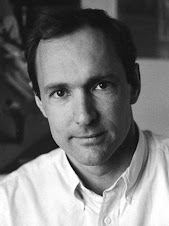
Believe it or not, there was no Eureka, no moment or revelation, and not a flicker of the light bulb. Tim Berners-Lee, the genius, the father of the WWW, took many years to process the idea of linking information together. He had to challenge his ideas and probably experience a series of trial and error before getting what he wanted. Berners-Lee, who was born into a family of mathematicians, followed his parents' footsteps. His inspiration of the WWW came from an old Victorian book of "how to do..." He knew it would become a challenge because the computer hierarchies then were designed for logical organization and processing and had no advanced application that could link things together (he was yet to develop the random association of information into what we call WWW). In the end, he finally archived his goal and created the wonderful system in which we now call the internet. Although he became famous because of this discovery, he kept a low profile and tried to stay away from the mass media. (I really admire this side of him!)
Monday, January 11, 2010
Welcome
Hi, welcome to my technology page! I am hoping that this blog will inform you of the things that I have learned in TelNetWeb class during these past few months. But for now I guess I’ll begin with a little introduction.
Being the senior that I am, it’s quite exciting to be back in school after a nice Christmas break because it means that the graduation date will be that much closer. High School has been a fun experience especially when this is my first time entering such a large and diverse school. I’m originally from Asia so diversity there is very limited. And if you don’t already know, I’m actually a mix blood (Asian-American) who speaks 5 languages. (The hardest language that I have mastered so far is Javanese; the dialects drive me crazy!) My favorite hobbies include painting, listening to music, taking pictures, and scuba diving. So I guess this pretty much sums up my life!
Anyhow, TelNetWeb has been a blast this year! In my previous class I learned of how Cyber Bullying existed and how it can affect the life of a person drastically. This was proven by the Megan Meier incident. Another thing I learned was how the basic structure of html codes consists of:
• html
• head
• body
Also the COPA act was an interesting subject to study. Since internet is such a large system it was only right for the people to try to regulate what kids were being exposed to. In conclusion, these are just some of the things we learned so far. Hopefully there will also be other fun activities and projects to come!
Being the senior that I am, it’s quite exciting to be back in school after a nice Christmas break because it means that the graduation date will be that much closer. High School has been a fun experience especially when this is my first time entering such a large and diverse school. I’m originally from Asia so diversity there is very limited. And if you don’t already know, I’m actually a mix blood (Asian-American) who speaks 5 languages. (The hardest language that I have mastered so far is Javanese; the dialects drive me crazy!) My favorite hobbies include painting, listening to music, taking pictures, and scuba diving. So I guess this pretty much sums up my life!
Anyhow, TelNetWeb has been a blast this year! In my previous class I learned of how Cyber Bullying existed and how it can affect the life of a person drastically. This was proven by the Megan Meier incident. Another thing I learned was how the basic structure of html codes consists of:
• html
• head
• body
Also the COPA act was an interesting subject to study. Since internet is such a large system it was only right for the people to try to regulate what kids were being exposed to. In conclusion, these are just some of the things we learned so far. Hopefully there will also be other fun activities and projects to come!
Subscribe to:
Comments (Atom)